MAyanmar limits internet usage as protests against trilitary coup grow

Authorities cut internet lines in the country as thousands of people joined mass demonstrations on Saturday against an ongoing coup declared by Myanmar’s army. Protesters, often raising three fingers and wearing red ribbons, also expressed solidarity from India and Thailand on Friday. The civil disobedience campaign started on Monday, shortly after the army announced on military-run television that it had taken control and declared a year-long state of emergency. Civilian leader Aung San Suu Kyi and several other political figures have been arrested.

Myanmar police arrested 30 people for banging pots to protest the military coup. The military blocked Facebook to stop protest organizers, so people joined Twitter instead. Many are using a 3-finger salute also seen at protests in Thailand: "We have to resist this dictatorship."
Myanmar police arrested 30 people for banging pots to protest the military coup.
— AJ+ (@ajplus) February 5, 2021
The military blocked Facebook to stop protest organizers, so people joined Twitter instead. Many are using a 3-finger salute also seen at protests in Thailand: "We have to resist this dictatorship." pic.twitter.com/g9UafGBKDG
Myanmar saw its largest anti-coup protests yet on Saturday (Feb 6) with young demonstrators spilling on to the streets to denounce the country's new military regime, despite a nationwide Internet blackout aimed at stifling a growing chorus of popular dissent.
How the internet dropped off
The restrictions to the internet were reported on Monday at 03:00 local time (20:30 GMT on Sunday).
Internet connectivity had dropped to 50% of normal levels by 08:00 local time that day, as people were waking up to the news of the military takeover.
"Army cut off the state media TV and radios, local phone line and internet getting disabled across the country," tweeted Burmese Reuters journalist Wa Lone.
Around 3,000 demonstrators gathered on a road near Yangon University, most holding up the three-finger salute that has come to symbolise resistance to the army takeover.
Data from the internet monitoring service Netblocks shows disruptions on network operators, including state-owned Myanma Posts and Telecommunications (MPT) and an international operator, Telenor.
Netblocks says its findings indicate a "centrally ordered mechanism of disruption... progressing over time as operators comply".
By midday on Monday, internet connectivity had returned to 75% of normal activity.
However, on Wednesday the military blocked access to Facebook, which has been used by activists to co-ordinate opposition to the coup.
Update: Facebook products are now restricted on multiple internet providers in #Myanmar as operators comply with an apparent blocking order.
— NetBlocks (@netblocks) February 3, 2021
Data show variations by provider, with MPT targeting a wider range of the company's services than Telenor 📉
📰 https://t.co/Jgc20OBk27 pic.twitter.com/RkdE2mdWFQ
In the first such demonstration since the generals seized power on Monday, activists chanted: "Military dictator, fail, fail; democracy, win, win," and held banners reading "Against military dictatorship". Bystanders offered them food and water.
For the overwhelming majority in Myanmar, Facebook is the primary means of access to the internet.
Some users are managing to circumvent the ban by using VPNs, which encrypt an internet connection so its location is not identifiable.
- What is a VPN service?.
Users in the country are rushing to download VPN apps to allow them to do this.
There has been a 4,300% increase in the demand for VPN, according to Top10VPN.com, which conducts research on these services.
The authorities have said blocks on Facebook will remain in place until 7 February.
Many in the crowd wore red, the colour of Aung San Suu Kyi's National League for Democracy (NLD) which won Nov 8 elections in a landslide, a result the generals have refused to recognise, claiming fraud.
As the protest swelled and activists issued calls on social media for people to join the march, the country's Internet crashed.
Regional variations
Some parts of Myanmar, also known as Burma, were more restricted than others.
Based at Monash University in Australia, the IP Observatory, which tracks internet connectivity around the world, found that some regions were severely disrupted.
Magway region was reporting zero internet connectivity at one point.
Yangon region, which includes the country's largest city, dropped in connectivity to about 50% compared to normal times. Restricting internet in the major cities is likely to be more difficult, as users will have access to a wider variety of providers that may implement restrictions at different intensities and at different times.
Most regions are now reporting an increase in internet connectivity.
Monitoring group NetBlocks Internet Observatory reported a "national-scale Internet blackout", saying on Twitter that connectivity had fallen to 54 per cent of ordinary levels. Witnesses reported a shutdown of mobile data services and Wi-Fi.
The junta did not respond to requests for comment. It has tried to silence dissent by temporarily blocking Facebook and extended a social media crackdown to Twitter and Instagram on Saturday.
Norwegian mobile phone company Telenor Asa said authorities had ordered Internet providers to deny access to Twitter and Instagram "until further notice".
Many had sidestepped the ban on sites such as Facebook by using virtual private networks to conceal their locations, but the more general disruption to mobile data services would severely limit access to independent news and information.
"Internet already down but we will not stop raising our voice," wrote a Twitter user with the handle Maw Htun Aung. "Let’s fight peacefully for democracy and freedom. Let’s fight until the last minute for our future."
Myanmar civil society organisations appealed to Internet providers and mobile networks to challenge the junta's orders blocking Internet access.
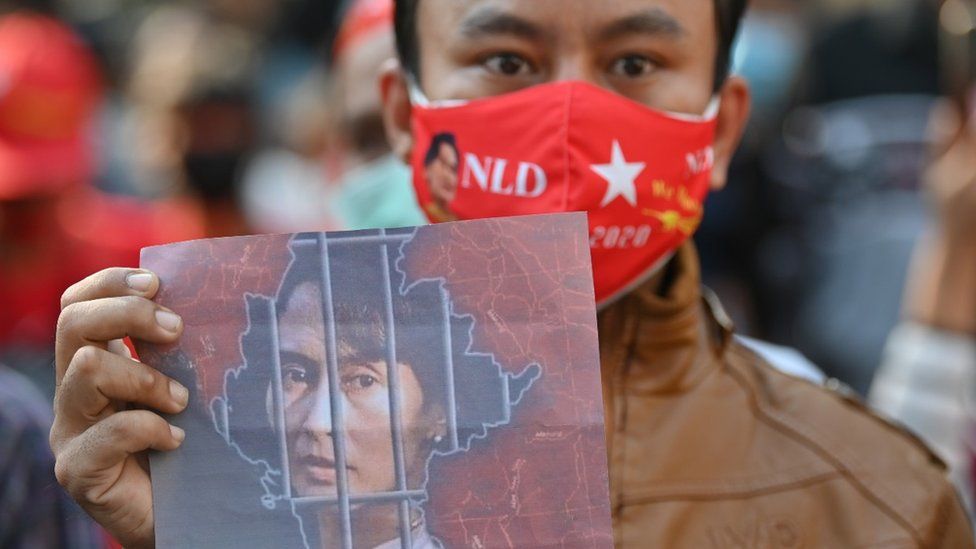
A history of disruption in Myanmar
The Myanmar government has restricted the internet before, especially in areas in Rakhine and Chin states, where the army is fighting local groups. Hundreds of thousands have been displaced by the conflicts.
Article 77 of Myanmar's Telecommunications Law, passed in 2013, is used by the government to cut off telecommunications during a national emergency.
However, human rights groups have called for the law to be amended to protect freedom of expression and have criticised the broad scope of the law.
There were also concerns that health information about Covid-19 was being restricted to some parts of the country, because of an internet shutdown in 2020.
How do governments do it?
A government can disrupt the internet by ordering internet service providers (ISPs) to limit access.
This can include blocking particular sites, such as popular social media platforms. A message such as "server not found" or "this site has been blocked by the network administrator" will show up.
Another method is known as "throttling" - when the bandwidth to a website is limited, making the internet slow and frustrating to use.
Finally, telecoms providers can shut down all access to the internet.
In theory, a telecoms company could challenge a government order. But in countries where the government has a tight grip on the media and can threaten to revoke licences, the willingness to push back on such demands is limited.
"By complying with their directives, your companies are essentially legitimising the military’s authority, despite international condemnation of this very body," a coalition of groups said in a statement.
Telenor said before the Internet shutdown that it was legally obliged to follow the order to block some social media, but "highlighted the directive’s contradiction with international human rights law."
Amnesty International’s deputy regional director for campaigns, Ming Yu Hah, said shutting down the Internet amid a coup and the COVID-19 pandemic was a "heinous and reckless decision".
Army chief Min Aung Hlaing seized power alleging fraud although the electoral commission says it has found no evidence of widespread irregularities in the November vote.
The junta announced a one-year state of emergency and has promised to hand over power after new elections, without giving a time frame.
INTERNATIONAL PRESSURE
The takeover drew international condemnation, with a United Nations Security Council call for the release of all detainees and targeted sanctions under consideration by Washington.
Aung San Suu Kyi, 75, has not been seen in public since the coup. She spent some 15 years under house arrest during a struggle against previous juntas before the troubled democratic transition began in 2011.
The lawyer for Aung San Suu Kyi and ousted President Win Myint said they were being held in their homes and that he was unable to meet them because they were still being questioned.
Aung San Suu Kyi faces charges of importing six walkie-talkies illegally while Win Myint is accused of flouting COVID-19 restrictions.
Sean Turnell, an Australian economic adviser to Aung San Suu Kyi, said in message to Reuters on Saturday that he was being detained.
Saturday's protest is the first sign of street unrest in a country with a history of bloody military crackdowns on protesters. There were also anti-coup protests in Melbourne, Australia, and the Taiwanese capital Taipei on Saturday.
A civil disobedience movement has been building in Myanmar all week, with doctors and teachers among those refusing to work, and every night people bang pots and pans in a show of anger.
In addition to about 150 arrests in the wake of the coup reported by human rights groups, local media said around 30 people have been detained over the noise protests.
The United States is considering targeted sanctions on individuals and on entities controlled by Myanmar's military.
Secretary of State Antony Blinken pressed top Chinese diplomat Yang Jiechi in a phone call on Friday to condemn the coup, the State Department said.
China, which has close links to Myanmar's military, joined the consensus on the Security Council statement, but has not condemned the army takeover and has said countries should act in the interests of the stability of its neighbour Myanmar.
UN Myanmar envoy Christine Schraner Burgener condemned the coup in a call with Myanmar's deputy military chief Soe Win, and called for the immediate release of all those detained, a UN spokesman said.
The generals have few overseas interests that would be vulnerable to international sanctions, but the military's extensive business investments could suffer if foreign partners leave - as Japanese drinks company Kirin Holdings said it would on Friday.
US-based pressure group Human Rights Watch called for the lifting of the Internet restrictions, the release of detainees and an end to threats against journalists.
"A news and information blackout by the coup leaders can’t hide their politically motivated arrests and other abuses," said Asia director Brad Adams.


No comments:
Post a Comment